



By DESIGNCRAFT LTD | Engineering Solutions
Introduction
In industrial engineering, the durability of a steel structure depends not only on its mechanical strength and material properties but also on the quality of its surface preparation and corrosion protection system.
Sandblasting, technically known as abrasive blasting, is one of the most effective methods of preparing steel surfaces before applying industrial protective coatings.
At DESIGNCRAFT LTD, we recognize surface preparation as a critical engineering process for improving coating adhesion, reducing corrosion risks, and extending the service life of industrial equipment.
1. What Is Sandblasting?
Abrasive blasting is a mechanical surface-treatment process in which abrasive particles are accelerated toward a material using compressed air or specialized blasting equipment.
When the abrasive particles strike the steel surface, their kinetic energy removes unwanted materials, including:
- Rust and corrosion products
- Mill scale formed during steel manufacturing
- Old paint and deteriorated coatings
- Surface contaminants and loose deposits
- Other unwanted surface layers
The process also produces a controlled microscopic surface roughness, commonly called the surface profile or anchor profile.
This surface profile helps protective coatings adhere effectively to the steel substrate.
2. The Physics Behind Abrasive Blasting
The effectiveness of abrasive blasting is influenced by particle velocity, abrasive mass, impact angle, hardness, and surface characteristics.
The kinetic energy of an abrasive particle can be expressed as
- (E_k) = kinetic energy (J)
- (m) = mass of the abrasive particle (kg)
- (v) = particle velocity (m/s)
Because kinetic energy is proportional to the square of velocity, increasing particle speed can significantly increase the energy available during impact.
However, higher impact energy does not automatically mean better surface preparation. Excessive blasting intensity can cause undesirable surface deformation, embed abrasive particles, or produce an unsuitable surface profile.
For this reason, blasting parameters must be selected according to the steel condition, abrasive characteristics, and coating manufacturer’s requirements.
3. Surface Cleanliness Standards: ISO 8501-1
One of the most widely recognized international standards for evaluating blast-cleaned steel surfaces is ISO 8501-1.
The standard provides visual preparation grades for steel surfaces.
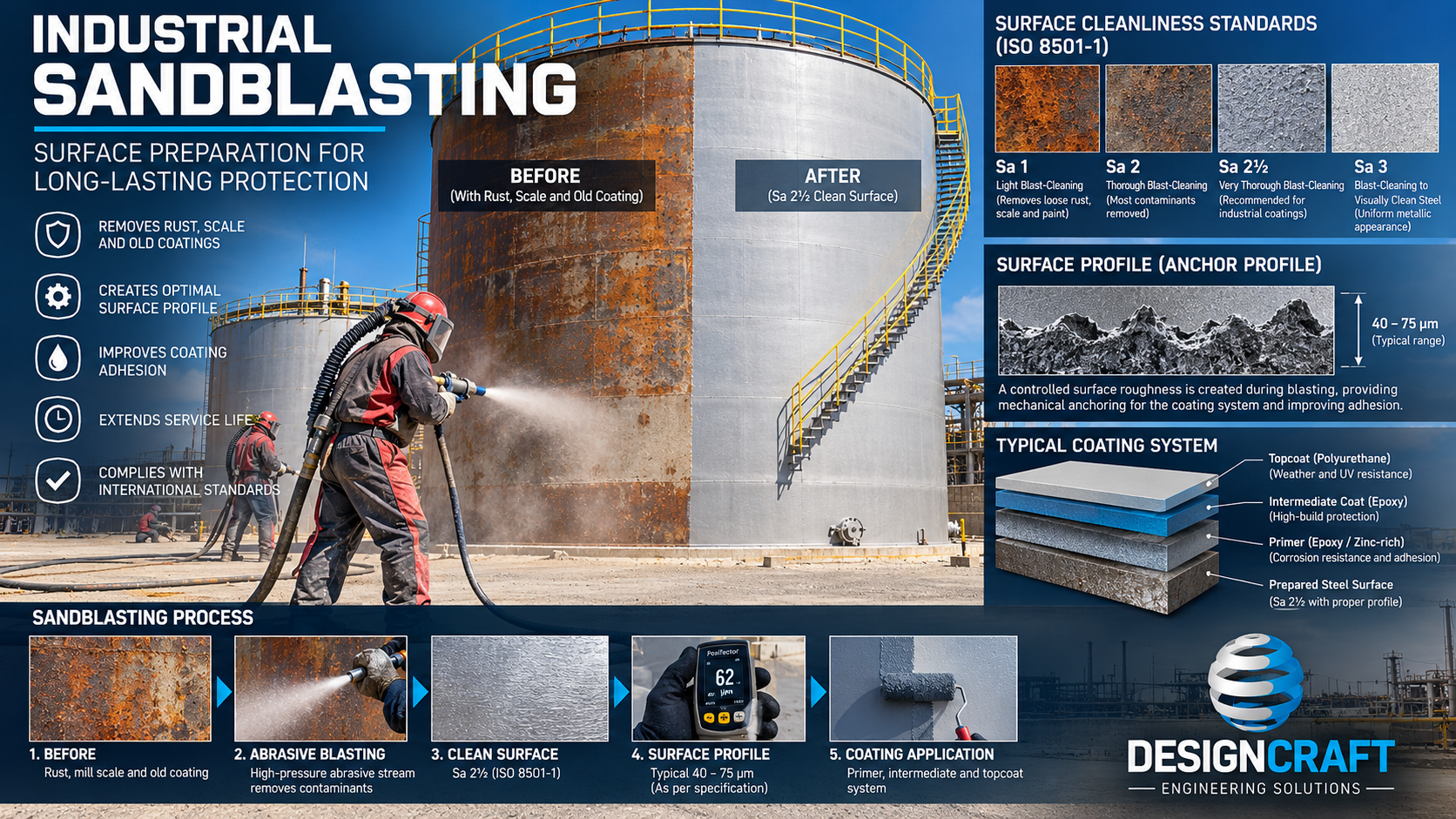
Sa 1 — Light Blast-Cleaning
Removes poorly adhering rust, mill scale, paint, and foreign matter.
Sa 2 — Thorough Blast-Cleaning
Removes most visible contaminants, with remaining material required to be firmly adhering.
Sa 2½ — Very Thorough Blast-Cleaning
Removes visible oil, grease, dirt, mill scale, rust, paint coatings, and foreign matter. Any remaining traces must appear only as slight stains in the form of spots or stripes.
Sa 3 — Blast-Cleaning to Visually Clean Steel
Produces a uniformly metallic appearance with no visible contamination.
For many industrial protective coating systems, Sa 2½ is a commonly specified preparation grade, subject to the applicable project specification and coating requirements.
4. Surface Roughness and Coating Adhesion
Surface cleanliness alone is not sufficient to guarantee coating performance.
The surface profile generated by blasting is another critical parameter.
When abrasive particles strike steel, they create microscopic peaks and valleys. These irregularities provide a mechanical anchoring effect for subsequently applied coatings.
Surface profile requirements depend on the coating system and are commonly evaluated using methods described in the ISO 8503 series.
For some heavy-duty protective coating systems, a surface profile in the approximate range of 40–75 µm may be specified, although the correct range must always be determined from the coating manufacturer’s technical data sheet.
An excessively smooth surface may provide inadequate mechanical anchoring, while excessive roughness can leave coating peaks insufficiently covered.
5. Environmental Conditions and Surface Contamination
Abrasive blasting and painting operations are strongly influenced by environmental conditions.
Important parameters include:
Relative Humidity: High humidity increases the risk of moisture condensation and flash rusting.
Steel Surface Temperature: The steel temperature must remain sufficiently above the dew point to reduce condensation risk. A minimum difference of 3°C is commonly specified, unless the coating specification requires otherwise.
Soluble Salt Contamination: Chlorides and other soluble salts can remain on steel surfaces and contribute to premature coating failure.
Dust Contamination: Residual abrasive dust can interfere with coating adhesion and surface cleanliness.
These conditions should be inspected and recorded before coating application.
Relevant standards include ISO 8502 for surface cleanliness testing and ISO 8503 for surface profile characterization.
6. Sandblasting and Industrial Coating Systems
Following proper surface preparation, industrial steel components may receive protective coating systems selected according to their service environment.
Common systems include:
- Epoxy primers: Provide corrosion resistance and adhesion to prepared steel.
- High-build epoxy coatings: Provide protective barrier properties for industrial service.
- Polyurethane topcoats: Offer color retention and resistance to weathering and ultraviolet exposure.
- Zinc-rich primers: Provide galvanic corrosion protection when correctly specified and applied.
Coating selection depends on operating temperature, chemical exposure, atmospheric conditions, immersion service, and required design life.
ISO 12944 provides an internationally recognized framework for the corrosion protection of steel structures using protective paint systems.
7. Quality Control and Inspection
A professional abrasive blasting and painting operation should incorporate systematic quality control.
Important inspection activities include:
- Visual inspection of surface cleanliness against the specified preparation grade.
- Measurement of the surface profile.
- Verification of surface temperature, ambient temperature, relative humidity, and dew point.
- Testing for dust and soluble salt contamination when required.
- Verification of coating application conditions and recoat intervals.
- Measurement of dry film thickness (DFT).
- Coating adhesion or holiday testing where specified and appropriate.
Proper inspection helps reduce premature coating failure and supports long-term corrosion protection.
8. DESIGNCRAFT LTD: Industrial Surface Preparation Solutions
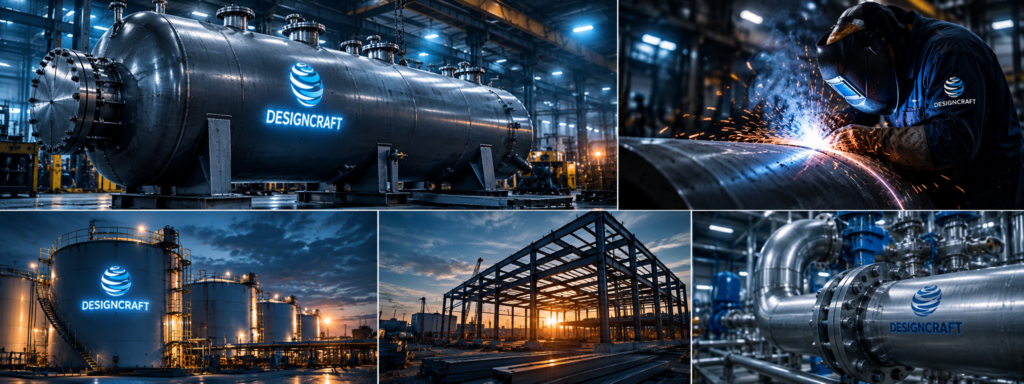
At DESIGNCRAFT LTD, abrasive blasting and protective coating activities form an important part of our industrial engineering and fabrication capabilities.
Our services cover surface preparation and corrosion protection for:
- Above-ground storage tanks
- Pressure vessels
- Steel structures and industrial frameworks
- Piping systems and mechanical components
- Industrial equipment and fabricated steel assemblies
We emphasize appropriate surface preparation, coating compatibility, environmental monitoring, and quality inspection according to project requirements.
Conclusion
Industrial sandblasting is much more than a cleaning operation. It is a controlled mechanical process that directly influences coating adhesion, corrosion resistance, maintenance requirements, and the long-term performance of steel structures.
By combining established surface preparation standards, engineering principles, and appropriate protective coating systems, industrial facilities can improve equipment reliability and reduce lifecycle maintenance costs.
DESIGNCRAFT LTD — From Kurdistan to the World, We Deliver Excellence.
📍 Erbil, Kurdistan Region, Iraq
🌐 www.designcraftltd.com
Leave a Reply